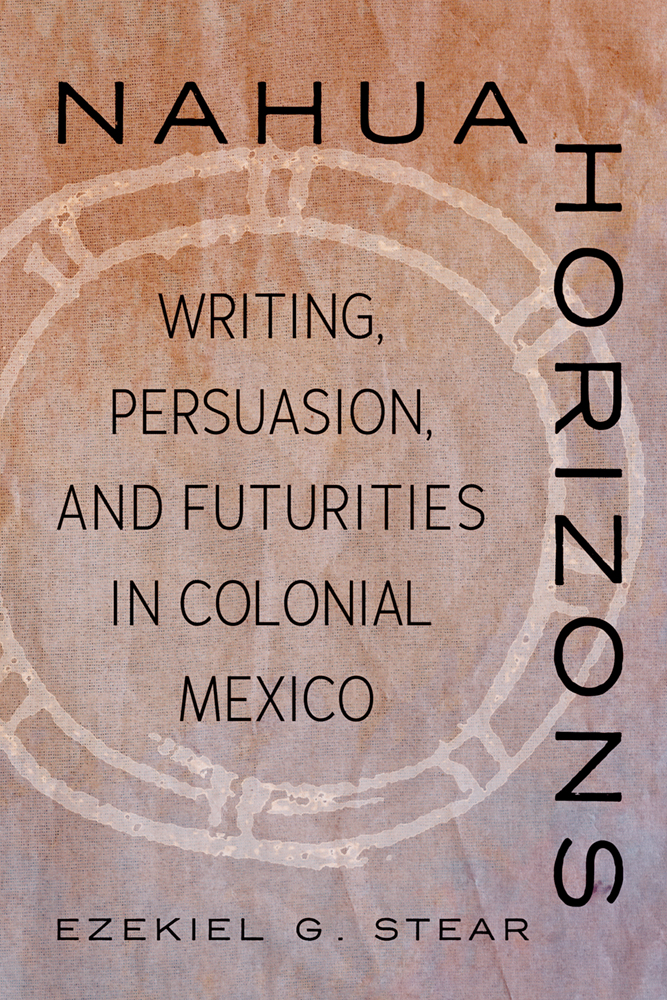
I am pleased to announce that my book with the University of Arizona Press, entitled, Nahua Horizons: Writing, Persuasion, and Futurities in Colonial Mexico, is now available for preorder from the University of Arizona Press’s website and on Amazon. The official release date will be Februrary 18, 2025.
This is an exciting moment that many of you who follow me here have watched over the years. I began this blog in 2018, when I was teaching at colleges in Southern California, working on some of my first publications, and giving cultural tours in Mexico and Peru.
This book is the one that I wish I could have read when I was younger and visited Central Mexico for the the first time. I was fascinated to find one of the only places in the world, where Indigenous sites stand next to colonial cathedrals and in the shadow of modern skyscrapers. I started to ask myself, how did Mexico become Mexico?
That search led me to 7 years of graduate study at the University of Kansas (2008-2015), and another 9 years of research (2015-2024) before the book arrived at its present form. Part of the answer to how Mexico became Mexico has to do with Indigenous choice. I found evidence of conscious deliberations and choices in Nahua communities. The Nahuas were the largest Indigenous group in Mexico during the colonial period and 1.5 native speakers of their language of Nahuatl remain today. The Nahuas, despite the pressures of the colonizing Spaniards, took concrete action to shape their own futures.
Here is what academics are saying about the book:
“In Nahua Horizons Stear draws our attention to Nahua futurities, ways in which Nahua communities and individuals interpreted and defined their futures in the wake of the trauma of Spanish invasion and colonization. Engaging the work of a range of Indigenous scholars and scholarship, this book enhances our understanding of sixteenth- and seventeenth-century Nahua pictorial and alphabetic texts by showing how Nahua writers envision a future-oriented representation of Indigenous culture and society and persuade their communities to act to create that reality.”—Amber Brian, author of Alva Ixtlilxochitl’s Native Archive and the Circulation of Knowledge in Colonial Mexico
“Nahua Horizons is an erudite analysis of the different ways that Nahuas deployed the written word, both pictographic and the Roman alphabet, to chart a way into the future on their own terms. With fresh approaches to a series of canonical Nahua materials, Stear shows how writing was a crucial tool for Nahuas to strategically shape and respond to specific contexts, guide their people, and envision their future. This is exactly what one would hope the new generation of Nahua studies scholars would do: Nahua Horizons generously builds on the exceptional scholarship of previous generations, provides sensitive and expert readings of Nahuatl-language materials, and pushes the field forward in a way that insists on Nahua self-determination.”—Kelly McDonough, author of Indigenous Science and Technology: Nahuas and the World Around Them
It’s a joy to share this news with my readers here, and I look forward to taking up a more active blogging schedule, now that the book is coming out. Please feel free to share this with anyone who you think would be interested.
If you are involved with any academic department, or a group outside of the university setting who might be interested in a public event, please let me know. Perhaps you would be interested in hosting a public conversation between an expert on the period at your institution and myself. In this case, the conversation would involve how the Nahuas forged a path ahead into an uncertain future during the early years of colonialism, despite the pressures from Spanish invaders.
Saludos cordiales and my best regards. Let me know what you think in the comments!
 Forgotten Lives of Latin America